Selkirk Power Air Review: Fast Swing, Real Trade-Offs
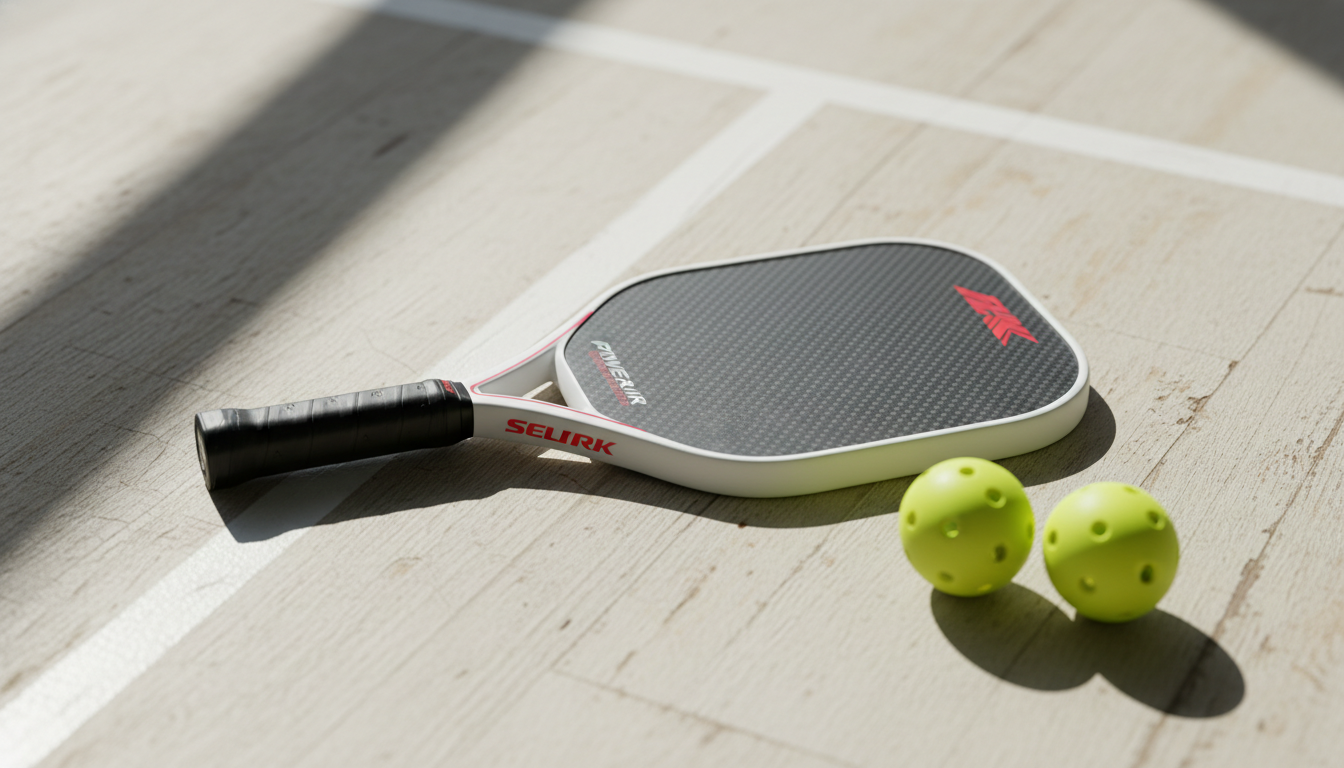
The Selkirk Power Air targets players who want a lightweight, fast-swinging paddle without sacrificing too much pop. It delivers on that promise — with one meaningful catch you need to know before buying.
What Selkirk Built Here
The Power Air uses Selkirk’s SuperCore polymer honeycomb core paired with a carbon fiber face and a proprietary Air Dynamic frame — essentially a hollowed-out edge guard that cuts swing weight significantly. The result is a paddle that feels almost eerily light in motion, somewhere in the 7.5–7.9 oz range depending on which grip size you pick up.
The face texture is aggressive. Selkirk’s carbon fiber skin grabs the ball well for spin generation, and at pace you can feel it biting during drives and rolls. It’s not the grittiest surface on the market, but it’s competitive with paddles in the $150–$200 range.
The shape is elongated — 16.5 inches long with a 7.375-inch width — which pushes the sweet spot slightly higher toward the tip. That’s intentional for reach and power, but it does make consistent centering more important.
How It Performs in Play
Speed and maneuverability are the obvious strengths. At the kitchen line, you can reset and redirect faster than with most paddles above 8 oz. Flick volleys and ATP attempts feel responsive rather than sluggish. Players moving from a heavier setup will notice the difference in the first five minutes.
Power is solid but not explosive. The Air Dynamic frame stiffens the paddle structurally, so energy transfers cleanly on full swings. But compared to a thermoformed paddle like the Joola Hyperion CFS 16, you give up some raw pop. This isn’t a demolition paddle; it rewards technique over brute force.
Spin numbers are respectable. Selkirk’s carbon texture is well-executed, and you’ll generate enough RPMs to make serves and third-shot drops curve meaningfully. It won’t outperform a raw carbon face like those on Gearbox or Franklin paddles, but it’s in the upper tier for spin among Selkirk’s own lineup.
Control and touch are where opinions split. The lightweight feel aids quick hands, but some players find the feedback slightly hollow — less of the “thud” that tells you exactly where the ball hit the face. If you rely on tactile feedback to self-correct, expect a short adjustment period.
Who It’s Actually For
The Power Air suits intermediate-to-advanced players who prioritize speed of play over raw power. Specifically:
- Bangers who’ve been told to slow down but don’t want to sacrifice maneuverability
- Left-side (even) players who live at the non-volley zone and need quick hands
- Doubles players who value dink control and fast resets more than driving lanes
- Players coming off arm or shoulder issues who benefit from a lighter swing weight
It’s a harder sell for baseline-heavy singles players or anyone whose game depends on punching pace through the court. The paddle rewards a controlled, touch-oriented style.
Compared to the Competition
The Selkirk Vanguard Power Air Invikta is the elongated cousin in the same family — useful context if you’re deciding between Selkirk shapes. The standard Power Air is more forgiving across the face.
Against the Paddletek Bantam EX-L Pro, the Power Air wins on spin and modernity but costs more. The Bantam has warmer feel and a more traditional swing weight that some veteran players prefer.
Against the Franklin Ben Johns Signature paddle, the Power Air is lighter and faster but gives up some of the raw spin advantage that raw carbon face provides.
If you’re cross-shopping within Selkirk, the Selkirk SLK Halo Control XL is worth considering if touch and forgiveness matter more to you than swing speed. It’s a softer feel at a lower price point.
Real-World Durability and Value
Selkirk’s build quality is consistently above average. The Power Air holds up to regular hard play without delamination or edge guard separation — two failure points on cheaper paddles. The grip starts tacky and stays usable well past 40+ hours of play.
At its retail price point (typically $180–$220 depending on retailer and availability), it’s expensive but not overpriced for the category. You’re paying for genuine engineering, not just branding. That said, if your budget stops at $150, the Halo line gets you 85% of this paddle’s performance.
The edge guard is proprietary — if it cracks, it’s not a standard repair. That’s a minor but real consideration if you’re hard on equipment.
Bottom Line
The Selkirk Power Air is a well-built, fast-swinging paddle that earns its price for kitchen-dominant players who want carbon fiber performance without heavy swing weight. It won’t out-power a thermoformed paddle, but that’s not what it’s designed to do. Buy it if speed of hand and dink precision define your game; skip it if you need raw driving power.