Pickleball Court vs Tennis Court: Key Differences
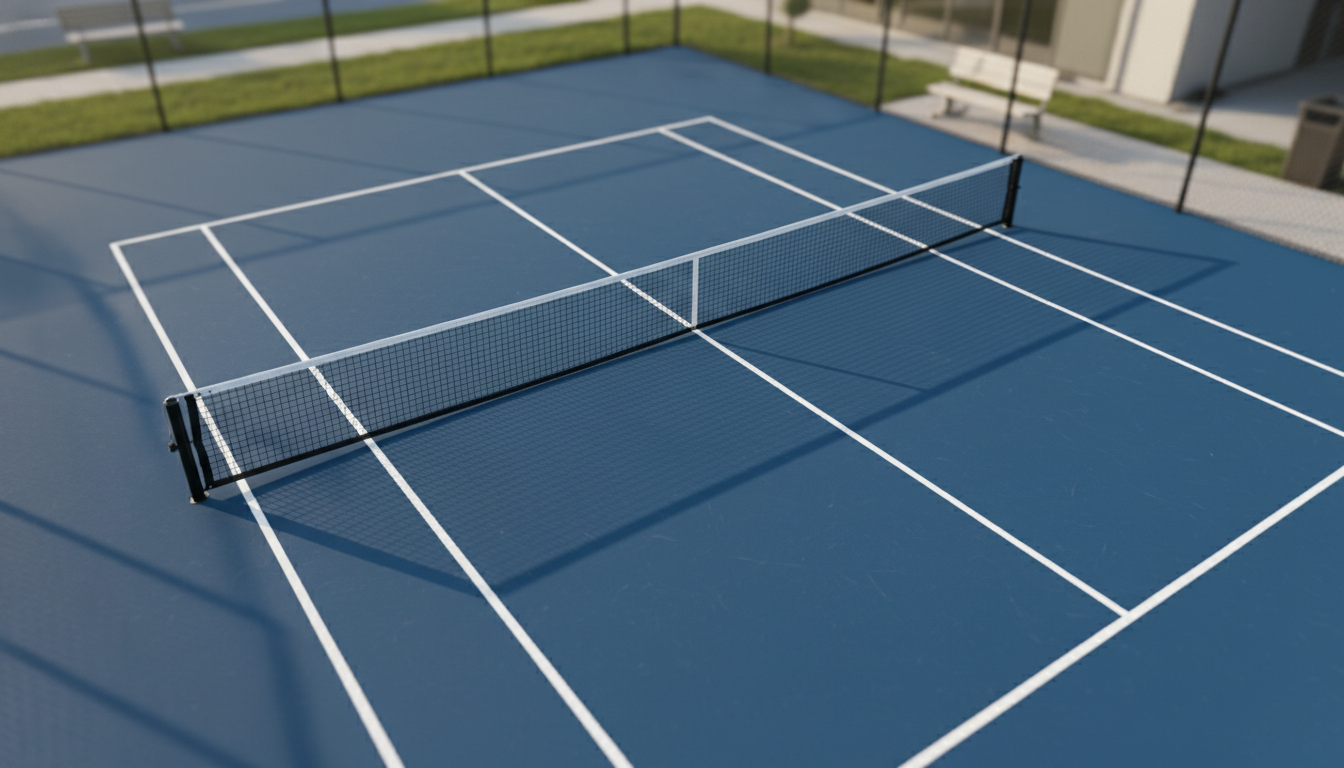
A pickleball court and a tennis court are not interchangeable — they differ in size, net height, and how the space gets used. If you’re deciding which to build, book, or convert, the numbers matter more than the general idea that “pickleball is smaller.”
Size Is the Biggest Difference
A standard pickleball court is 20 feet wide by 44 feet long. A tennis court is 36 feet wide by 78 feet long for doubles (27 feet wide for singles). That’s roughly 880 square feet of playing surface versus 2,808 square feet — pickleball takes up about one-third the space.
That size gap is why four pickleball courts fit inside a single tennis court with room to spare. It’s also why community centers and parks are converting existing tennis facilities instead of building new ones.
The smaller footprint changes everything about the game. Players cover less ground, the kitchen (no-volley zone) dominates strategy, and rallies tend to be shorter and more precise than the baseline-heavy exchanges in tennis.
Net Height and Kitchen Rules
Both sports use a net across the center, but the heights differ. A pickleball net sits 36 inches at the posts and 34 inches at the center. A tennis net is 42 inches at the posts and 36 inches at the center.
That 2-inch difference at center is subtle, but it changes shot selection. Dinking low over a pickleball net requires precise angle management. Tennis players who move to pickleball often overhit at first because they’re used to clearing a higher center net.
The kitchen — the 7-foot non-volley zone on each side of the pickleball net — has no equivalent in tennis. It forces a different tactical approach entirely: you can’t just move to the net and volley everything away.
Court Surface and Footwear
Both sports are commonly played on hard acrylic surfaces, but the requirements aren’t identical. Outdoor pickleball courts often use a textured acrylic coating over concrete or asphalt. Tennis courts vary more — hard courts, clay, and grass are all sanctioned.
Surface matters for shoes. Tennis shoes are designed for lateral movement on larger courts with more sprinting. Pickleball shoes handle shorter, quicker lateral cuts in a confined space. Something like the ASICS Gel-Renma Pickleball is built specifically for the stop-and-go demands of the kitchen game. Wearing running shoes on either surface is a fast way to roll an ankle.
If you’re playing pickleball on a converted tennis court with older, slicker paint, grip becomes a real concern. Check the surface condition before you commit to aggressive lateral movement.
Converting a Tennis Court to Pickleball
One tennis court can fit four dedicated pickleball courts, or two if you want buffer space between them. The conversion process involves:
- Painting new boundary lines (pickleball lines are typically a contrasting color to avoid confusion)
- Installing temporary or permanent pickleball nets
- Optionally adding portable net posts or permanent anchor sleeves
A portable net like the Oncourt Offcourt PickleNet handles temporary setups without drilling. For permanent conversions, anchor sleeves set in concrete run a few hundred dollars per court in materials, with labor on top.
The main friction point is shared facilities. Tennis players don’t love their courts overrun by pickleball lines, and overlapping line configurations can get visually confusing. Dedicated pickleball courts — purpose-built — solve that entirely, but require the square footage and budget.
Building New: What It Actually Costs
A new dedicated outdoor pickleball court — concrete slab, acrylic surface coating, net, and fencing — typically runs $20,000–$40,000 per court depending on your region, contractor, and whether you need lighting. A tennis court runs $60,000–$100,000+ for the same build quality, largely because of size.
Indoor courts carry different cost structures based on existing facility conversion versus new construction. For a backyard setup, a 20x44 pickleball surface is achievable where a full tennis court is not for most residential lots.
If budget is the constraint, pickleball wins on every line item.
Which One Should You Build or Book?
If you’re choosing between booking a pickleball court and a tennis court to try pickleball, just book the pickleball court. The dimensions, net, and kitchen lines are purpose-built for the game.
If you’re converting existing tennis infrastructure, go for it — just use dedicated-color lines and a proper net at the right height. A Gamma Portable Pickleball Net with official 34-inch center height makes the conversion play correctly.
If you’re building from scratch and pickleball is the goal, don’t overbuild. A properly surfaced 20x44 court with quality fencing is all you need.
Bottom line: Pickleball courts are smaller, cheaper to build, and tactically distinct from tennis courts — not just a scaled-down version of the same game. Know the dimensions, get the net height right, and wear the right shoes for the surface.